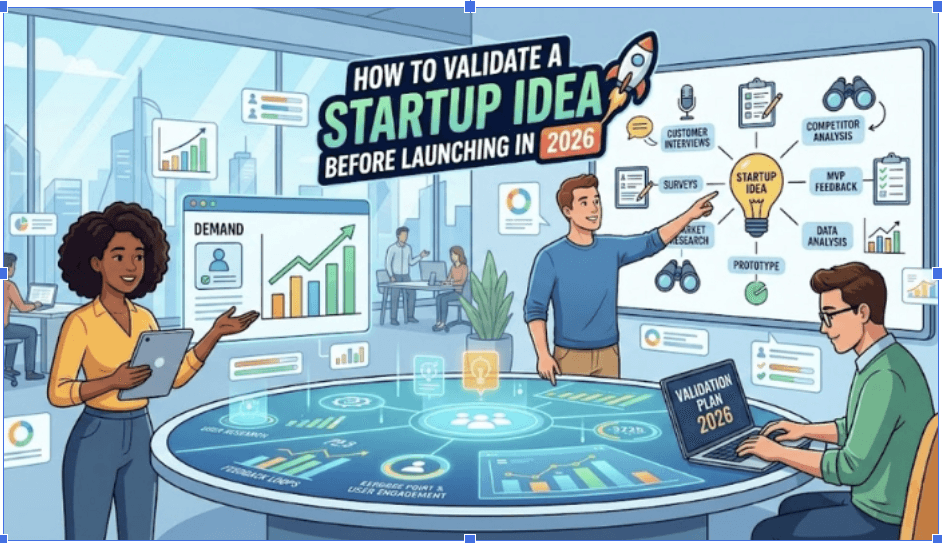
Launching a startup in 2026 is easier than ever from a technology standpoint but succeeding is still incredibly difficult. Over the years, I’ve learned that most startup failures don’t happen because founders lack passion or skill. They fail because they skip startup idea validation and build products nobody truly needs.
In this guide, I’ll walk you through exactly how I approach validating a business idea before launch using proven startup frameworks, real-world validation methods, and practical tools. My goal is simple: help you reduce risk, save time, and make smarter entrepreneurial decisions before investing heavily.
Why Startup Idea Validation Matters More Than Ever
Today’s startup ecosystem moves fast. AI tools, no-code platforms, and global competition mean anyone can build quickly. But speed without validation often leads to wasted resources.
When I validate an idea early, I’m not trying to prove I’m right — I’m trying to discover whether the market agrees with me.
Startup idea validation helps answer critical questions:
- Does a real problem exist?
- Do people actively want a solution?
- Will customers pay for it?
- Is the market large enough?
Validation shifts entrepreneurship from guessing to evidence-based decision-making.
Understanding Startup Risk Levels
Not all startup ideas carry the same level of uncertainty. Before I even begin testing, I assess risk.
Low-Risk Startup Ideas
These usually include:
- Improvements to existing solutions
- Known markets with clear demand
- Problems founders personally understand deeply
Validation focuses mainly on differentiation and pricing.
High-Risk Startup Ideas
These involve:
- Creating entirely new markets
- Complex technology adoption
- Assumptions about user behavior
Here, pre-launch validation becomes essential because assumptions can easily be wrong.
The Hidden Risk: Founder Bias
One of the biggest dangers I see is emotional attachment. Founders often validate ideas emotionally instead of objectively. Real validation comes from customer behavior — not opinions.
My Step-by-Step Smart Validation Framework
Over time, I’ve developed a structured process to test startup idea viability before building a full product.
Step 1: Define the Core Problem
I start by writing one clear sentence:
“This product helps [specific user] solve [specific problem].”
If I cannot define the problem clearly, the idea isn’t ready.
Step 2: Talk to Real Customers
Customer discovery is the foundation of validation. I conduct interviews focusing on:
- Current frustrations
- Existing solutions they use
- How much the problem costs them
I avoid pitching my idea. Instead, I listen carefully.
Step 3: Validate Business Idea Online
The internet makes validation faster and cheaper than ever. Here’s how I typically validate business ideas online:
- Create a simple landing page explaining the solution
- Run small traffic campaigns
- Measure sign-ups or waitlist interest
- Analyze behavior instead of opinions
Real actions matter more than compliments.
Step 4: Build a Minimum Test (Not a Full Product)
Instead of coding immediately, I test demand using:
- Mockups
- Prototypes
- No-code demos
- Service-based simulations
This approach validates value before development costs increase.
Step 5: Measure Demand Signals
I focus on measurable indicators:
- Email signups
- Pre-orders
- Demo requests
- Willingness to pay
Interest without commitment rarely equals validation.
Pre-Launch Validation Strategies That Actually Work
Waitlist Testing
A strong waitlist shows genuine curiosity and early demand.
Smoke Tests
I present a product offer before building it to see whether users click or sign up.
Prototype Feedback
Interactive prototypes help users experience the concept without full development.
Behavioral Surveys
Instead of asking “Would you use this?”, I ask:
- “When did you last face this problem?”
- “What solution did you try?”
Behavior reveals truth.
Best Idea Validation Tools I Personally Use
1. Survey & Research Tools
Used for structured customer discovery and problem validation.
2. Landing Page Builders
I use them to:
- Explain value propositions
- Collect emails
- Run conversion experiments
3. Analytics Platforms
These help track real user behavior:
- Click-through rates
- Engagement patterns
- Conversion signals
4. No-Code MVP Tools
Perfect for early product testing before hiring developers.
5. Market Research Platforms
Useful for identifying trends, competitors, and audience segments.
Common Startup Validation Mistakes (and Myths)
Myth 1: Friends and Family Feedback Is Validation
Supportive feedback is encouraging but biased.
Myth 2: Surveys Alone Prove Demand
Surveys measure interest, not commitment.
Myth 3: More Features Increase Validation
Complexity hides weak value propositions.
Myth 4: A Good Idea Sells Itself
Execution, timing, and positioning determine success — not idea quality alone.
Myth 5: One Positive Test Means Success
Validation is continuous, not a one-time milestone.
Realistic Long-Term Expectations
Even strong validation does not guarantee success. Markets evolve. Customers need change. Competitors react.
Validation reduces uncertainty — it doesn’t eliminate it.
Successful startups treat validation as an ongoing process:
- Test assumptions continuously
- Iterate based on data
- Adapt quickly to feedback
Product-market fit usually emerges gradually, not instantly.
Share Your Validation Experience
Every founder’s journey looks different. If you’re currently working through startup idea validation, consider reflecting on:
- What assumptions surprised you most?
- What feedback changed your direction?
- What validation method worked best?
Final Thoughts
Building a startup is no longer the hardest part — building the right startup is.
When you take time to test startup idea assumptions, perform thoughtful pre-launch validation, and use effective idea validation tools, you dramatically increase your chances of building something people genuinely want.
Key Takeaways
- ✓Idea validation reduces risk and prevents building products nobody needs
- ✓Start by understanding the real problem and talking to real customers
- ✓Run online tests, prototypes, and demand signals before writing code
- ✓Validation is ongoing, not a one-time milestone
Ready to validate your idea?
Get instant feedback on your startup idea using real customer conversations.
Validate My Idea